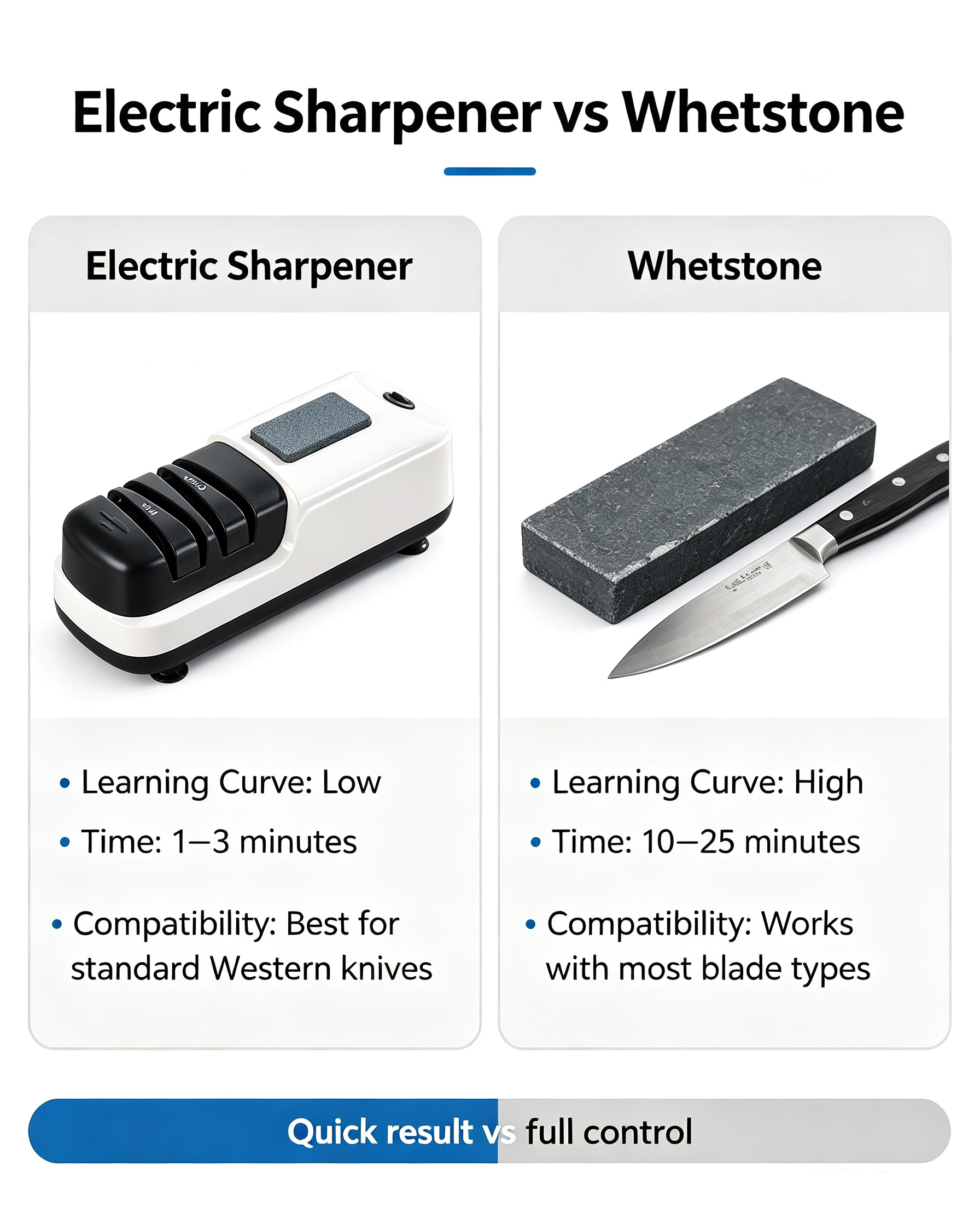
Electric Knife Sharpener vs Whetstone: Which Is Better?
Introduction
Many home cooks run into the same frustrating problem: dull kitchen knives. A blunt knife makes chopping slower, slips more easily, and creates messy cuts. When it comes to restoring sharp edges, two popular solutions stand out: the electric knife sharpener and the traditional whetstone (water stone).
Online content often oversimplifies this debate. Some claim whetstones always deliver superior edges, while others argue electric sharpeners make whetstones completely obsolete. The truth is, neither tool is universally “better”. Your cooking habits, skill level, time budget, knife collection and tolerance for learning curves will decide which fits you best.
This comparison skips generic marketing talking points. We look at real‑world kitchen performance, long‑term wear on blades, learning difficulty, maintenance and realistic scenarios for home users.
What Is an Electric Knife Sharpener, and How Does It Work?
An electric knife sharpener is a powered benchtop tool built with rotating abrasive grinding wheels or diamond sharpening slots. Most consumer‑grade models offer multi‑stage slots: coarse grinding for severely dull or damaged edges, fine sharpening, and finishing honing stages.
You simply pull the knife blade through designated slots at a steady pace. The motor‑driven abrasives remove metal from the blade to recreate a sharp cutting angle automatically.
Key trait: The machine controls sharpening angle for you. You do not need to manually hold a precise blade angle.
What Is a Whetstone, and How Does It Work?
A whetstone, also known as a water stone, is a rectangular block of abrasive material. Whetstones come in different grit ratings: low grit for repairing nicks and heavy reshaping, high grit for fine polishing the cutting edge.
Before use, you soak the stone in water. You then slide the knife blade across the stone’s surface by hand. You must manually maintain a consistent sharpening angle the entire time you work both sides of the edge.
Whetstones produce sharp edges, but output quality directly depends on your technique. Poor angle control leads to inconsistent edges, bent edges or wasted metal removal.
Head‑to‑Head Real‑World Comparison
1. Learning Curve & Time Investment
Electric Knife Sharpener
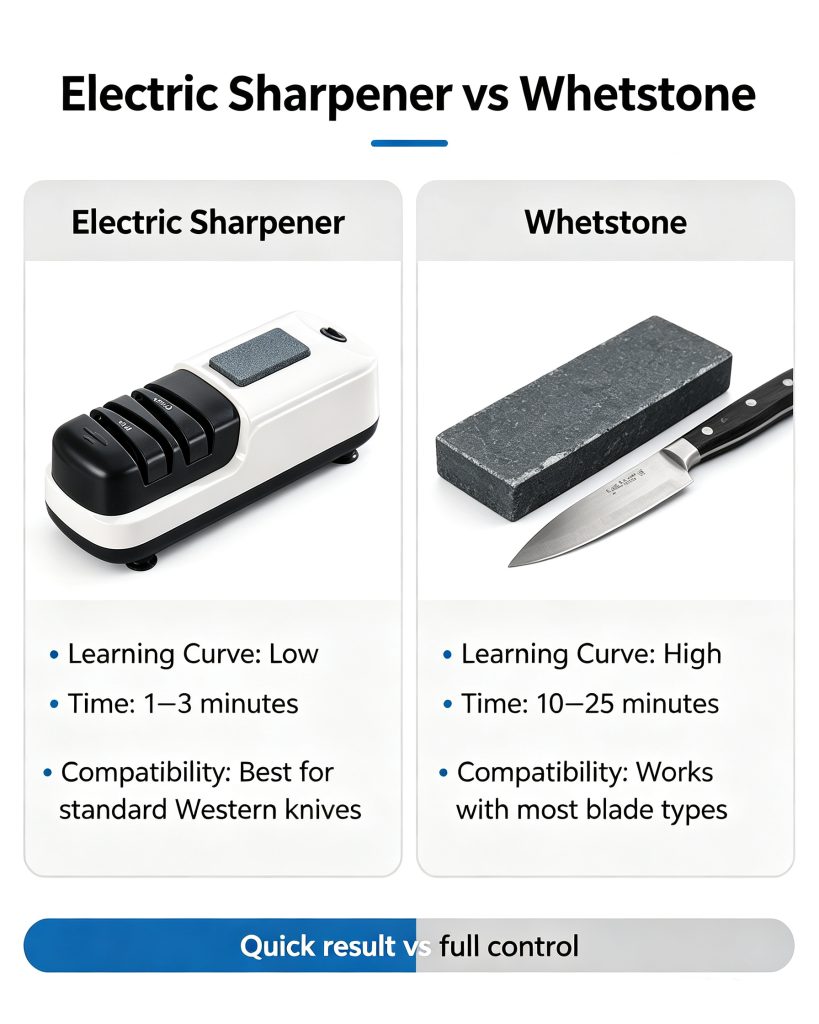
- Very low learning barrier. New users can get usable sharpness in 1‑3 minutes per knife.
- The built‑in slot geometry locks sharpening angle. Minimal practice required.
- Drawback: You still need to follow correct pulling speed; rushing can create uneven edges.
Whetstone
- Steep learning curve. Mastering consistent hand angle takes hours of practice.
- Sharpening one kitchen knife can take 10‑25 minutes, even for experienced users.
- If your angle drifts, you will get uneven cutting edges no matter how good your stone is.
Real‑world insight: Most casual home cooks never fully master whetstone angle control. Many hobbyists spend months practicing before they get reliable repeatable results.
2. Edge Quality & Blade Metal Removal
Electric Knife Sharpener
- Modern high‑quality electric sharpeners create clean, service‑ready edges for everyday kitchen tasks.
- Multi‑stage diamond‑based models can handle dull, nicked blades.
- Cons: Cheap low‑end electric sharpeners remove excessive metal fast, wearing down your knife over time. Poor‑quality wheels can leave coarse scratch patterns on the bevel. Premium units minimize over‑grinding.
Whetstone
- With proper technique, whetstones yield extremely polished, refined edges favoured by cooking enthusiasts.
- You get full manual control over how much metal you remove. You can do light honing or heavy damage repair.
- Cons: Bad technique can grind away more blade material than a decent electric sharpener. Angle wobble creates micro‑burrs that feel sharp but dull quickly during food prep.
3. Compatibility With Different Knives
Electric Knife Sharpener ✅ Works great for standard Western kitchen chef knives, utility knives, paring knives. ⚠️ Limitations: Many consumer electric sharpeners are fixed‑angle. They struggle with Japanese‑style thin‑angle blades, very thin custom knives or serrated knives (only specific models support serration sharpening). Some wide‑bolster knives cannot fully seat into sharpening slots.
Whetstone ✅ Extremely flexible. Works for Western knives, thin‑bevel Japanese knives, custom blades, pocket knives. You adjust your hand angle for each knife. ⚠️ Limitation: Serrated knives are tricky to sharpen on a flat whetstone without extra accessories.
4. Maintenance & Upkeep
Electric Knife Sharpener
- After‑use cleaning is required: you must empty metal shaving debris tray, clean grinding slots with a stiff brush to avoid metal dust buildup.
- Diamond‑abrasion sharpening heads wear slowly; heads will need replacement after heavy‑duty long‑term use.
- Keep unit dry; moisture inside causes motor failure or rust.
Whetstone
- Must soak before each sharpening session.
- The stone surface will develop uneven hollows over repeated use and needs periodic flattening with a lapping plate.
- After use, rinse and air‑dry slowly. Improper drying causes cracking.
- You need extra accessories: flattening stone, soaking container, optional angle guide.
5. Cost: Upfront & Long‑Term
Electric Knife Sharpener
- Entry‑level cheap units carry risk of over‑grinding blades. Reliable household‑grade electric sharpeners sit in the mid‑price bracket.
- Long‑term cost: replacement sharpening cartridges when abrasives wear out.
Whetstone
- You can buy affordable dual‑grit whetstones. Premium high‑quality stones are expensive.
- Extra ongoing costs: flattening plate, angle guides. A cheap poor‑quality whetstone wears unevenly and degrades quickly.
When Should You Choose an Electric Knife Sharpener?
Pick an electric knife sharpener if these match your situation:
- You want sharp knives fast, without spending hours practicing sharpening technique.
- You own mostly standard Western‑style kitchen knives.
- Multiple family members use knives; you want a foolproof tool anyone can safely operate.
- You do not want to invest time learning hand‑sharpening skills.
- You frequently rescue heavily dull, abused kitchen knives.
Tip: Always invest in a well‑reviewed mid‑range electric sharpener. Ultra‑cheap models will ruin good knives by aggressive over‑grinding.
When Should You Choose a Whetstone?
Choose a whetstone if these apply to you:
- You collect high‑end Japanese or custom knives with special sharpening angles.
- You enjoy knife‑maintenance as a hobby and are willing to invest time learning proper technique.
- You want maximum manual control over every aspect of your knife’s cutting edge.
- You sharpen many different unusual blade types beyond standard chef knives.
Important note: A whetstone does not automatically equal better results. A poorly‑executed whetstone sharpen yields worse performance than a decent electric sharpener used correctly.
Common Myths Debunked
Myth 1: Whetstones always produce sharper knives than electric sharpeners
Fact: Edge quality depends on operator skill. A skilled whetstone user gets excellent results. An untrained beginner on a whetstone often produces inconsistent edges. A quality modern electric sharpener delivers reliable sharpness for daily cooking.
Myth 2: Electric sharpeners destroy your knives
Fact: Only low‑cost poor‑quality electric sharpeners remove excessive metal. Premium diamond‑based electric sharpeners remove material conservatively, comparable to whetstone work. Misusing a whetstone can also wear down blades quickly.
Myth 3: Whetstones are the “professional only” choice
Fact: Many professional kitchen environments use electric sharpening equipment for high‑volume knife turnover. Whetstones are widely used by hobbyists and specialist chefs. Both tools exist in professional settings.
Final Verdict: Which One Is Better for You?
There is no universal winner.
- For most regular home kitchens: a quality electric knife sharpener is the most practical solution. It delivers consistent sharpness quickly, with minimal learning work. It fits busy households that just want working sharp knives for food preparation.
- For knife enthusiasts and owners of premium specialty blades: a whetstone is worth the learning investment, giving you full manual control over edge geometry.
Many users combine both tools. Use an electric sharpener for fast restoration of dull household knives, and use a whetstone for fine‑tuning your premium collection.
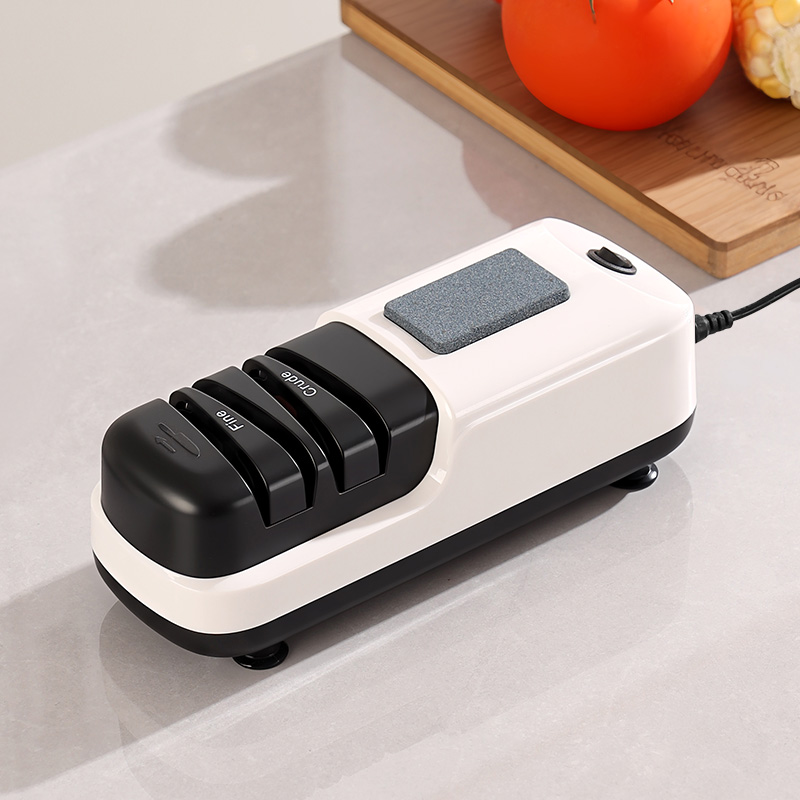
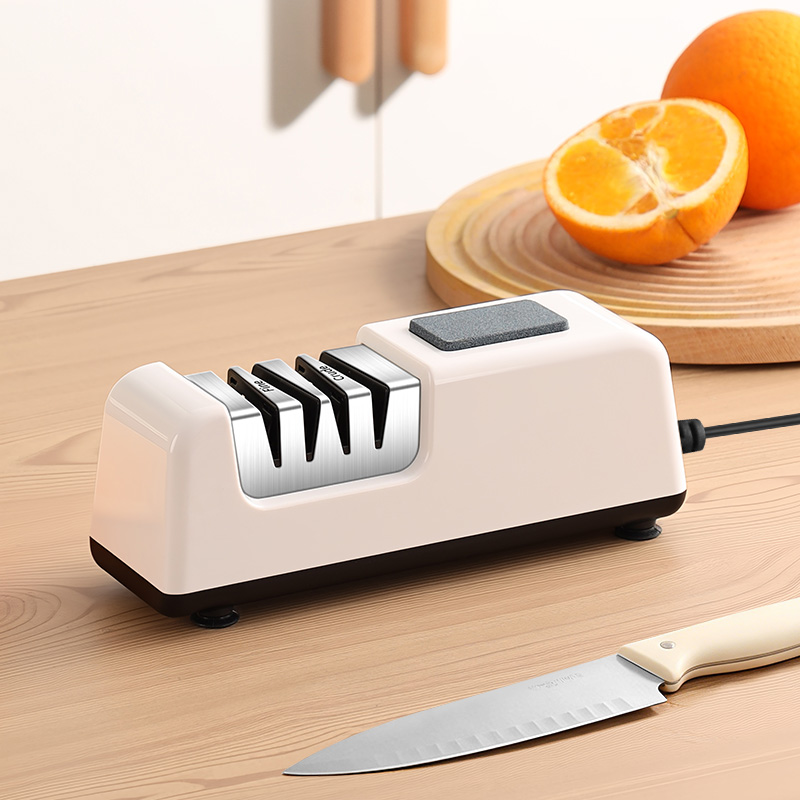
If you are ready to try an electric sharpener, our household‑grade model balances performance and ease‑of‑use for regular home cooking. It supports coarse repair and fine polishing, with handy built‑in honing stone.
FAQ
Can I use both an electric sharpener and a whetstone?
Absolutely. A common workflow: use electric sharpener for major edge repair, then finish with high‑grit whetstone polishing if you want an ultra‑refined edge.
Will an electric sharpener ruin my Japanese knife?
Most standard consumer electric sharpeners use fixed Western angles. They can alter the original thin factory bevel of Japanese knives. Look for angle‑adjustable electric sharpener models if you plan to sharpen Japanese‑style blades.
How often should I sharpen my kitchen knives?
Frequency depends on cutting surface and usage. For average home cooking: most knives need refreshing every 2‑4 months, depending on how heavily you use them.