Sharpening vs Honing: What’s the Difference? Complete Knife Care Guide
Sharpening vs Honing: What’s the Difference?
Many people believe that sharpening and honing are the same thing. Both are related to keeping kitchen knives performing well, and both can make a knife feel sharper. However, they actually solve different problems.
Understanding the difference between sharpening and honing can help you maintain your knives properly, extend their lifespan, and choose the right tool for your kitchen.
Can Honing Replace Sharpening?
The simple answer is: No.
Honing can improve the performance of a knife that is slightly misaligned, but it cannot restore a truly dull blade.
Imagine a knife edge like a thin metal line:
- If the line is slightly bent → honing can straighten it.
- If the line has become worn away → sharpening is required.
Many people repeatedly hone dull knives and wonder why the cutting performance does not improve. The reason is that the blade has already lost its sharp edge.
How Often Should You Sharpen and Hone Your Kitchen Knives?
The ideal schedule depends on how often you cook and the type of knife you use.
Daily Cooking
For people who cook every day:
- Hone: before or after frequent use
- Sharpen: approximately every 2–6 months
Occasional Cooking
For lighter kitchen use:
- Hone occasionally
- Sharpen once or twice a year
Factors that affect sharpening frequency include:
- Cutting surface material
- Knife steel quality
- Food preparation habits
- Storage methods
What Is Knife Sharpening?
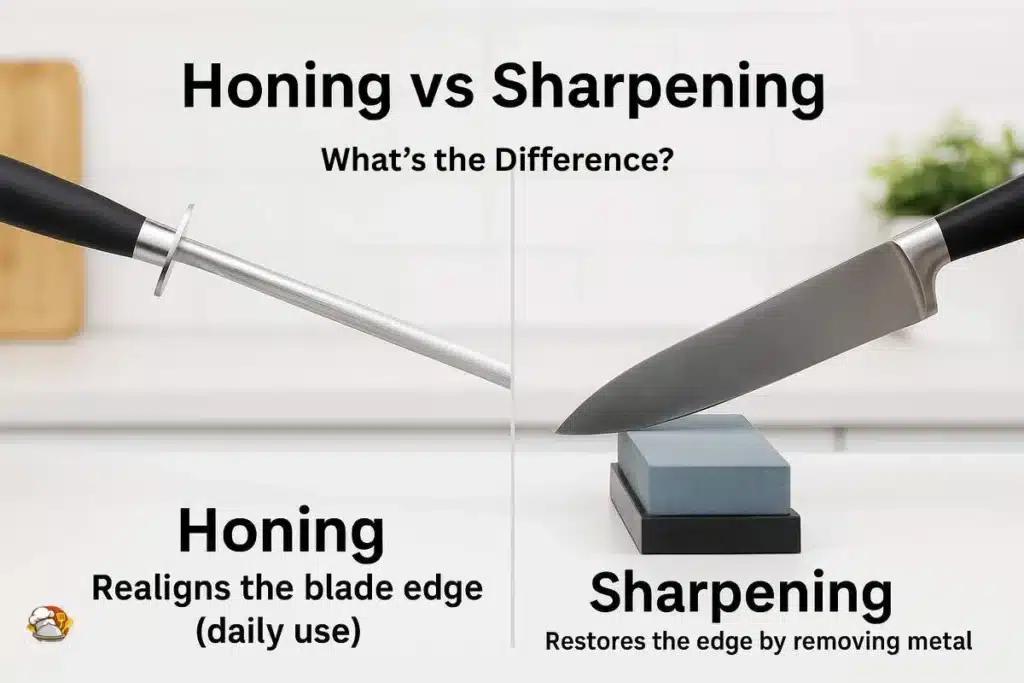
Sharpening is the process of removing a small amount of metal from the knife blade to create a new, sharper edge.
Over time, repeated cutting causes the knife edge to become dull. The very thin cutting edge may become rounded, damaged, or worn away. Sharpening restores the blade by grinding away the damaged metal and forming a fresh edge.
Common sharpening tools include:
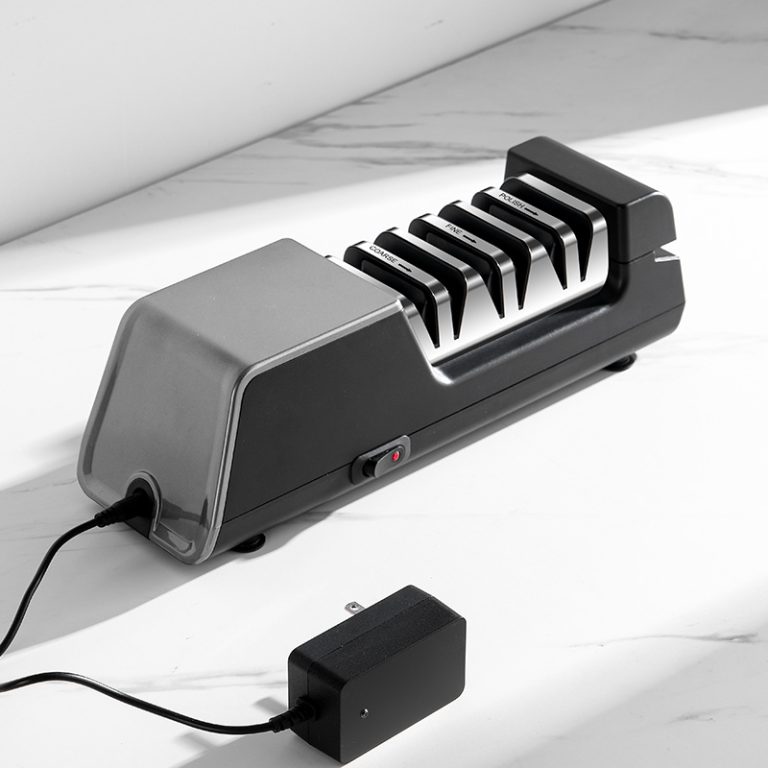
- Electric knife sharpeners
- Whetstones
- Manual sharpeners
- Professional sharpening machines
Unlike simple maintenance, sharpening actually changes the shape of the blade edge.
When Does Your Knife Need Sharpening?
Your knife likely needs sharpening when:
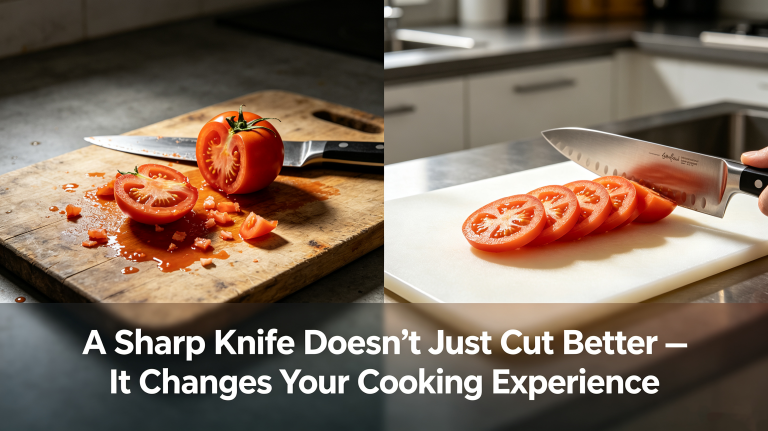
✔ It struggles to slice tomatoes or soft vegetables
✔ You need to apply extra pressure while cutting
✔ The blade slips instead of cutting smoothly
✔ Paper cutting tests become difficult
A sharp knife should cut with minimal effort and provide better control.
What Is Knife Honing?
Honing does not remove significant amounts of metal from the blade. Instead, it realigns the tiny edge of the knife that bends slightly during normal use.
Even a sharp knife can lose cutting performance because the microscopic edge becomes misaligned.
A honing rod pushes the edge back into position, helping the knife regain its smooth cutting ability.
Honing Is More Like Knife Maintenance
Think of honing as regular care for your knife.
For example:
- Sharpening = repairing and rebuilding the cutting edge
- Honing = maintaining the existing edge
Many professional chefs hone their knives frequently because it keeps the blade performing well between sharpening sessions.
Sharpening vs Honing: Key Differences
| Feature | Sharpening | Honing |
|---|---|---|
| Main purpose | Creates a new sharp edge | Straightens the existing edge |
| Removes metal | Yes | Very little or none |
| Frequency | Every few months depending on use | Before or after regular use |
| Tools | Electric sharpener, whetstone | Honing rod |
| Best for | Dull or damaged knives | Maintaining already sharp knives |
Can Honing Replace Sharpening?
The simple answer is: No.
Honing can improve the performance of a knife that is slightly misaligned, but it cannot restore a truly dull blade.
Imagine a knife edge like a thin metal line:
- If the line is slightly bent → honing can straighten it.
- If the line has become worn away → sharpening is required.
Many people repeatedly hone dull knives and wonder why the cutting performance does not improve. The reason is that the blade has already lost its sharp edge.
How Often Should You Sharpen and Hone Your Kitchen Knives?
The ideal schedule depends on how often you cook and the type of knife you use.
Daily Cooking
For people who cook every day:
- Hone: before or after frequent use
- Sharpen: approximately every 2–6 months
Occasional Cooking
For lighter kitchen use:
- Hone occasionally
- Sharpen once or twice a year
Factors that affect sharpening frequency include:
- Cutting surface material
- Knife steel quality
- Food preparation habits
- Storage methods
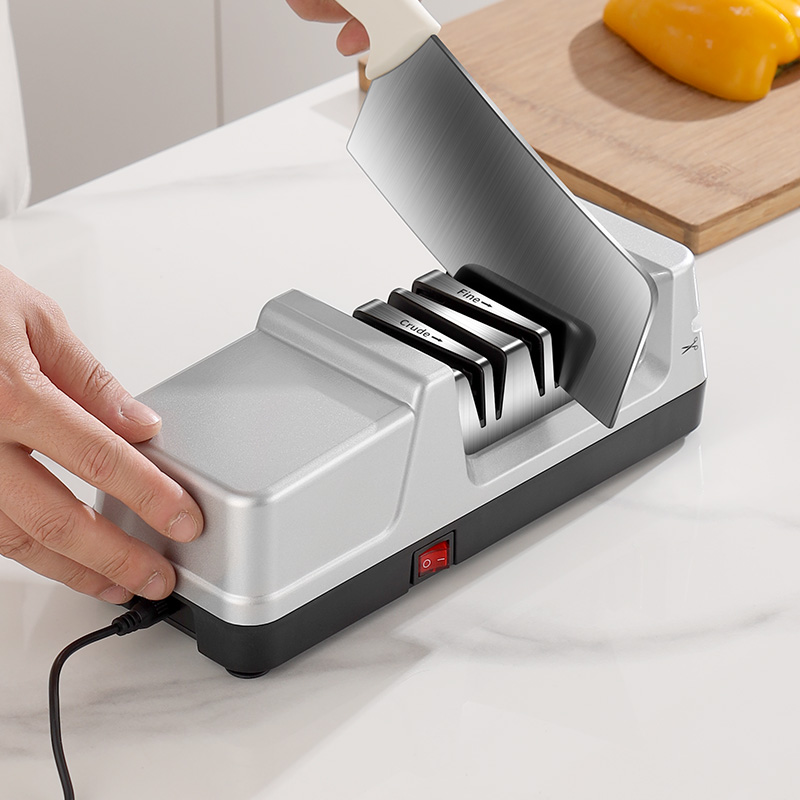
Why Electric Knife Sharpeners Make Sharpening Easier
Traditional sharpening methods require experience to maintain the correct angle and apply the right pressure. For beginners, achieving consistent results can be challenging.
Modern electric knife sharpeners simplify the process by using:
- Precise sharpening angles
- Multi-stage sharpening systems
- Diamond abrasive wheels
- Stable grinding performance
This allows users to restore knife sharpness quickly without years of sharpening experience.
For households, restaurants, and professional kitchens, an electric sharpener can be a practical solution for maintaining multiple knives efficiently.
How to Choose Between a Honing Rod and an Electric Knife Sharpener?
The best choice depends on your knife condition.
Choose a Honing Rod If:
✔ Your knives are already sharp
✔ You want daily edge maintenance
✔ You regularly maintain professional knives
Choose an Electric Knife Sharpener If:
✔ Your knives have become noticeably dull
✔ You want fast and consistent sharpening
✔ You have multiple kitchen knives to maintain
✔ You prefer an easy sharpening method
Many kitchens actually benefit from using both: honing for daily maintenance and sharpening for restoring performance.
Keep Your Knives Performing Like New
A good knife is an investment. Proper maintenance not only improves cutting performance but also makes cooking safer and more enjoyable.
While honing helps maintain your knife’s condition, sharpening is the key step when the blade starts losing its cutting ability.
With the right sharpening solution, even older kitchen knives can be restored to smooth, precise cutting performance.
A reliable electric knife sharpener provides an easy way to bring dull knives back to life — helping home cooks save time, reduce effort, and enjoy better cooking experiences every day.
-1-768x768.jpg)